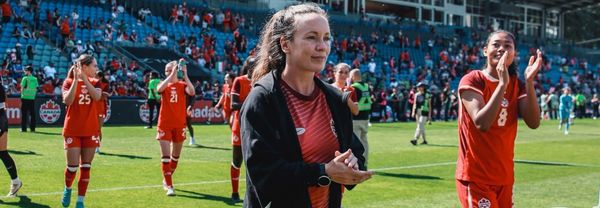
Casey Stoney preparing to reunite with Canadian team after lengthy layoff
In a 1-on-1 interview, Stoney discusses Canada's immediate future, the NSL's ambitions of becoming a top five league in the world, and much more.


You can subscribe to TFC Republic by CLICKING HERE, or by clicking on the subscribe button on the home page. A monthly subscription costs just $8, while a yearly subscription is $50 (a savings of 48%).
Casey Stoney doesn't like waiting around, but that's exactly what she's had to do all summer and will continue to do for the next little while.
There have been no FIFA international windows on the women's calendar since June when Canada earned a 6-0 road win over Costa Rica. As a result, Stoney hasn't been in camp with her players for over two months.
Rather than put members of her squad through their paces in training, Stoney has made use of the time off by, amongst other things, connecting with her mother who has stage four cancer, and serving as a TV commentator during the 2026 FIFA World Cup.
The Canadian women's team return to action when it faces Denmark in a pair of friendlies on Oct. 9 in Montreal and Oct. 12 in Toronto, marking its first home games since June 2025. After that, Stoney will turn her attention to November when Canada competes in the Concacaf W Championship in Texas, which serves as the qualifying tournament for both the 2027 World Cup in Brazil and the 2028 Olympics in Los Angeles.
In this one-on-one interview with TFC Republic, Stoney discusses Canada's upcoming matches vs. Denmark, preparing for the Concacaf W Championship, her thoughts on the Northern Super League and its ambitions to become one of the top five leagues in the world, and much more.
This Q&A has been lightly edited and trimmed for brevity and clarity.
With regards to the October international window, how did you settle on Denmark? Was there something specific about the Danish team's profile that made them a desirable opponent?
There are multiple reasons. Number one, they're a top European opponent that routinely qualifies for major tournaments. And to be able to get European opponents to come to Canada, that doesn't really happen that often.
They play a slightly different system. They play a 5-4-1 or a 5-3-2. So, they're more of a team that can come and high press you, but they can also sit off in a real low block. They have different tactical challenges, which if you're playing them in a group stage and they're sitting off, you've got to try and break them down to score. And that's an important piece for us – to play a top opponent that's really organized and defensively sound, but also very good in transition because that's something that if we're going to go and press teams, we have to get higher. The transition moments are key for us.
They haven't lost under this manager either, so they're super competitive, which makes them a good opponent for us for many reasons. When we play Panama [at the the Concacaf W Championship], it's highly likely they're not going to come out and press us really high. They're going to sit in. We'll have to break them down. So, playing Denmark does give us possible elements of that.
Some of it helps us prepare [for Panama], and some of it doesn't. Some of it is just about getting the best opponents we can play to test ourselves, to challenge ourselves, to continue to build performances and consistently play well. Denmark might sit off, Panama might sit off. So, there's some elements there that might cross over. Obviously, Denmark's a far higher ranked opponent, but I believe we test ourselves against the best to make it easier when it comes to the next games.
 John Molinaro
Setting aside the results, what is it you want to achieve with these two games against the Danes?
I think it's about building on our previous performances. 2026 has been quite positive for us in terms of goal scoring. There's been different challenges we've faced this year – We've gone over to Brazil, we've played in the SheBelieves Cup, we competed against the U.S., we scored good goals against Colombia. So, we've had a lot of different tests. I think this window is about getting some consistency in our performances. It's about making sure that we go into every game trying to win, and we continue to build those relationships and the things we've been building on, so that when we come to November, we're ready.
Do you envision fielding your strongest possible team against Denmark ahead of the Concacaf W Championship?
It's a Friday-to-Monday schedule, so it is a tight turnaround, and I do have to be mindful of the pro clubs as well. There'll be an element of fielding our strongest team, but there'll definitely be an element of some rotation in there; there has to be because it's coming into playoffs for a lot of clubs and I need to be respectful of that and I want people to be available for the November window. So, that's a key piece, but yes, we will be looking at going as strong as possible. But there's also a chance that certain players might not be picked for October to make sure that they're available for November.
Does the October window give you an opportunity to expand the player pool at all? Will you turn to some young or uncapped players?
I think there's a chance that, depending on fitness and health of some players who've been in the bubble in the last 12 to 16 months, if they're available, there might not be the need to look elsewhere. But as I have said, the door is always open. We're always looking at people who are in form and playing well. The European leagues are just starting up so we've got to see where they're at. We've got to see where the NWSL players and the NSL players are at. I'm always assessing who's best to come into this squad, and we need to make sure we pick the strongest squad that we have available to us.
By the time these games against Denmark come around, it will have been four months since Canada played a game, which obviously is not ideal. Every women's national team is in the same boat because there hasn't been a FIFA window since June, but how challenging is it for you as a coach to work with players after such a long time away from them?
It's really difficult, but that's why we have to make sure that in between we're staying connected to the players, we're making sure to have conversations, we're watching their games, and we're having touch points because four months is far too long. The fact that FIFA took out the September window is really disappointing. The fact that window is gone is huge, because that would have given us another touch point before October. October for us is a friendly window and for some other teams. But for other teams it could be the start of qualifying for a major tournament, and you've not seen your team for four months, so it's definitely challenging.
We will try and hit the ground running when we come in, so that players are prepared coming into camp. They know all the information they need, so we can really just get on the grass and start working, get reconnected, and get prepared for the game in Montreal.
Do you have a sense of why FIFA didn't have a window in September?
I think what they've tried to do, from my understanding, is to go for slightly longer windows to reduce the number of transitions between environments to reduce injuries. We've only had five windows this year, going into a World Cup year, which it's not enough in my opinion; nowhere near enough. But I think it's based on player health and welfare, so I can understand why they've done it.
Is there an avenue by which you and/or Canada Soccer can voice your displeasure to FIFA about the lack of windows on the women's calendar for 2026?
When FIFA holds the draw for the World Cup in December, there'll be time to have those conversations. There are times to be measured about it and make sure that we're coming from an educated point of view because five windows isn't a lot ahead of a World Cup year.
In recent weeks, we've seen three members of the national team move from either the NWSL or Europe into the NSL: Marie-Yasmine Alidou (Montreal Roses FC), and Shelina Zadorsky and Sabrina D'Angelo (AFC Toronto). Did any of those players consult you before making those moves?
I spoke to all of them. All came to the NSL for very different reasons but, generally, I think there was a sense that they'd like to be closer to home at this stage of their careers. Part of it was, "I need to be playing and getting minutes and feel like I'm in an environment where I'm valued." That was the case for at least one of them.
We had conversations about how do they keep their standards really high? How do they drive the environment that they're in? How do they make sure they're competing every single week? How do they make sure that they're doing the right things consistently? And they all seem really happy, and I think that's also really important. It's important that they're happy, they're playing, they're getting consistent playing time, and I'm pleased for all three of them.
Would you like to see more of your national team players make the move to the Northern Super League? Or is it about them playing in the most competitive environment that they can get?
It's about playing in the most competitive environment they can get, and also an environment that fits them. I'll never tell a player where to play. All I can do is advise them on what the playing style and what the leagues are like, and what's best for their kind of profile. But I'll never tell them where to play. I think it's important they make those decisions for their career.
 John Molinaro
At the same time, it is a big boost for the NSL that it is getting three players of this calibre, would you not agree?
Oh, it's massive. It's huge. I think it really helps the league grow. It helps the profile of the clubs. It's a huge opportunity for the NSL when the Canadian national team players do come play in the league.
Diana Matheson has talked about making the NSL a top five league in the world. You watch a lot of football from different leagues from around the world. In your view, is the NSL one of the world's top five leagues right now?
I think that's where they're trying to get to. I watch a lot of football. Their ambition is to get inside the top five. You can't think in year two that you're going to be there, and I don't think that's a realistic measurement to make right now. I do think it's grown. I think it's improved. I think it's more competitive. I think the recruitment's been good from some of the clubs. Personally, I would like to see more of our young Canadian players playing significant minutes, being given a chance within that league. So, I think the NSL has still got a bit to go to get inside that top five.
The Canadian Premier League has a rule dictating each team must have 2,000 minutes played by their domestic under-21 players by the end of the regular season. Further to your point about more young Canadians getting significant minutes, should the NSL introduce a similar rule?
It's something that's being discussed. I was part of the English WSL when that was set up [in 2010], and there was very strict governance around how many English qualified players you had to have in your team and many had to be part of the starting 11. I think the problem is if you said they just have to be part of your squad, you end up actually hurting young players because they just stick them on the bench and then they don't play. So, it is definitely being discussed within Canada Soccer of how we can continue to push for more playing time across the women's youth pathways into the NSL and it's definitely a conversation I support.
Giving more young Canadians a chance to play significant minutes in the NSL would have long-term benefits for you and the national team.
Absolutely, and for me, my job is to keep improving the program and to try and get us to a point of global success. And to do that, we have to look after our youth players. We have to continually push for youth players to be in the right environments, to get as many minutes as possible, and they learn by playing. They don't learn by sitting on a bench every single week.
Speaking of young players, Olivia Smith recently won the Professional Footballers' Association Young Player of the Year award for a second time in a row. What did you make of her 2025-26 season with Arsenal following her transfer from Liverpool?
Well, number one, she hasn't been in enough. I think she's missed something like 50 per cent of camps for Canada since I've been manager. So, I haven't seen the best of Olivia yet in a national team shirt; definitely not. But what I will say is this: She's not only won that award two years in a row, she's done it for two different clubs and I think to be able to do that in the second year, after being sold for quite a big price tag, that puts pressure on you to then go into a dressing room full of world class players and egos and everything that comes with that to be able to establish yourself and get yourself established quite quickly. I think that shows how good she is as a player. She knows she's got lots to grow and learn because she's 22, right? So, there's an element of her game that needs to continue to improve, but there's a real talent there, a special talent that we need to look after and we need to protect.
How high of a ceiling do you see for her? To what heights do you think she can climb to both at the club and national team level?
I think she could – and I say could with caution – be one of the best players on the global stage. But you've got to be fit, you've got to be available, and you've got to perform on the global stage to do that. I think one of our big things is how do we keep her fit and healthy? How do we keep her available to play for the national team? I think she's got a special skill set in that she can create and score for herself. The way she strikes a ball is something I've not seen very often in the women's game. In terms of how hard she can hit a ball, she's very creative and she can play off the cuff a little bit and do things that other players can't do, which for the national team is great in terms of being in the final third and creating more chances to score goals.
But we need her to be fit and available to be able to do that. I think she's gone through a big season at Arsenal. But now people will know more about her. They'll know how to mark her, and she's probably going to have to come up with different solutions. So, she's going to keep evolving. I think the sky's the limit to whatever Olivia wants to reach.
RELATED READING: News | Features | Match reports | Newsletter | Opinion | Q&As | Roster moves | TFC 2 | Audio | Videos
You've spent some time with Jesse Marsh when the men's national team has been in camp, and no doubt you've picked his brain. What's the working relationship like between you two?
Very good; really good. We texted after games during the World Cup. I'll text him a few times; we've just met in Toronto and spent two or three days together. We're going to head down to his house in Mexico and do some more work there in September. Whenever I've been in camp with Jesse, he's been really supportive. He'll watch our games. He'll give me feedback. He'll ask me questions. It's probably the most interaction I've ever had with my male counterpart during my coaching career. He's a really good guy; high energy. He wants the best for both programs, and I think we're quite aligned in that. It's really, really refreshing to be able to work with someone that's so open like him.
That lack of interaction you've had with male coaches at clubs you've previously managed...
It says a lot about football. [laughs]
Have you borrowed anything from Jesse? Is there something that he does that you've applied to how you oversee the women's team?
As coaches, we're always picking up ideas and different ways of doing things. He's got a very clear identity and the way he wants his team to play. I think we've tried to adopt a little bit of that. But there are also nuances between the men's and the women's game. One shoe size doesn't fit all. I've watched his teams. I love the intensity that they play at. I like the way they press and counter-press, and those elements are definitely a part of our game that we're trying to improve and the way we can be more dynamic.
He's a high energy person. I can't be anything other than me. If I tried to be like Jesse, then people would say, "Who's this imposter?" He is who he is. I am who I am. He's authentically himself and unapologetically himself, and I try to be that too. And I think we have a really good relationship. He's a great guy. I really enjoyed working with him, spending time with him, and just talking football because it's quite refreshing to be around someone who has so much passion for the game.
Circling back to the Denmark game, can you speak to how difficult it is for Canada Soccer just to arrange matches against top-level opponents, especially at home? There are serious challenges and obstacles, particularly on the women's side, to overcome in order to arrange these friendlies, correct?
Huge challenges because there's so many financial implications of inviting teams over and how much compensation they ask to come over and play. And let's not forget, Canada has its own unique challenges in terms of landscape. There's not that many grass pitches. Many are turf. I think the women's game is moving more towards not wanting to play international games on turf because of the amount of ACL injuries that happen. I'm not saying the injuries are because of turf, but there's definitely a concern around playing on turf. For six months of the year, we can't play on the East Coast because of the weather.
If you're flying European teams to the West Coast, some teams won't do it because it's such a long flight. If you think about Europe, they've got such a competitive market on their doorstep; they can play each other within two or three hours of flying. So, for them to come to Canada, it sometimes doesn't make sense for them.
TFC Republic subscribers can get up to a 25% discount on ticket prices for Toronto FC home games during the 2026 MLS regular season and the 2026 Canadian Championship. To receive the special promo code, email me at jmo1897@gmail.com
(Please don't share promo code with non-TFC Republic subscribers).